
Glazing, Roofing & Protection Panels
Polycarbonate Sheets Manufacturer
Solid, multiwall, corrugated, honeycomb, textured and flame-retardant polycarbonate sheets for greenhouses, skylights, canopies, roofing systems, industrial glazing, machine guards and architectural projects.
- Solid, hollow and profiled sheet options
- UV, optical and fire-grade review
- Custom size, color and fabrication support
- Profiles, connectors and export packaging
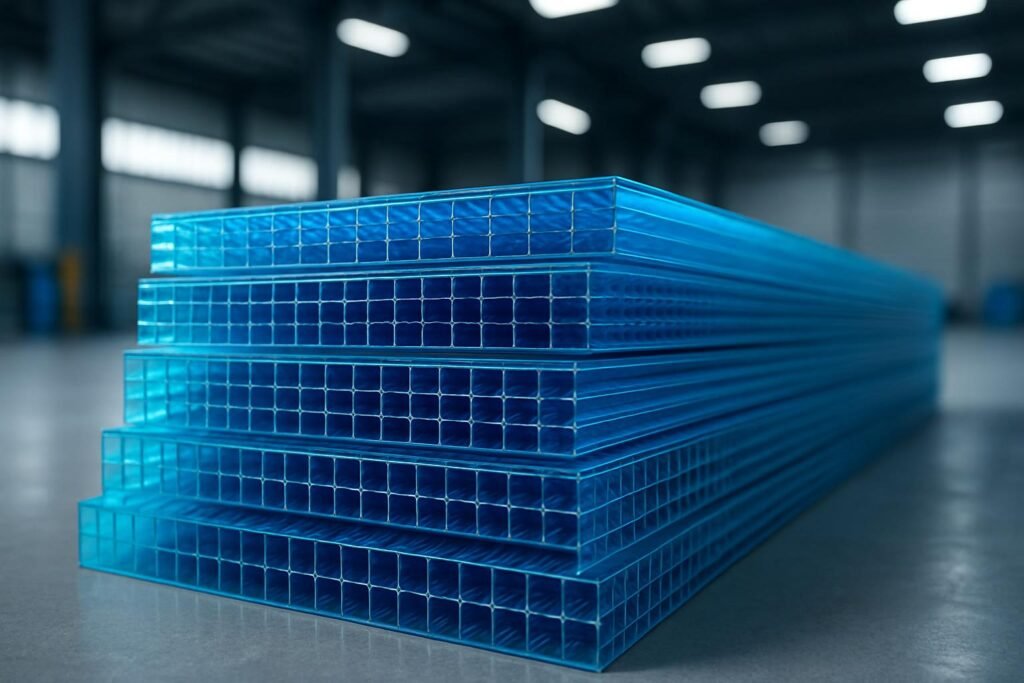
Polycarbonate sheets are thermoplastic panels manufactured in solid, hollow multiwall, profiled or textured forms. They are selected where a project requires a combination of light transmission, impact performance, lightweight construction, fabrication capability or thermal insulation.
The word “polycarbonate” does not define one universal product. Thickness, wall structure, profile geometry, color, UV layer, surface texture, fire grade and installation system can change the performance and correct application.
Product types
Choose the correct polycarbonate sheet structure
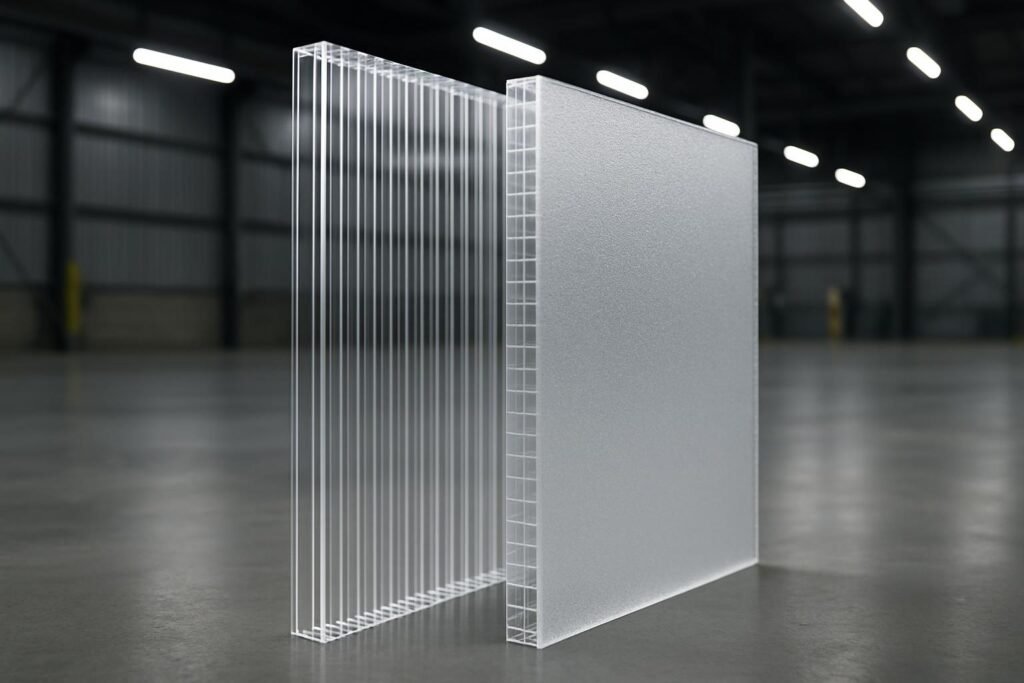
Solid Polycarbonate Sheet
Flat sheet for safety glazing, machine guards, windows, canopies, fabrication and formed components.
- Clear, colored and selected surface options
- Cutting, drilling, bending and forming review
- Outdoor UV layer available by grade
Multiwall Polycarbonate Sheet
Hollow sheets with internal walls and air spaces for greenhouses, skylights, roofs and wall glazing.
- Twin-wall and multiwall structures
- Light transmission and insulation balance
- Open-edge sealing and connector planning
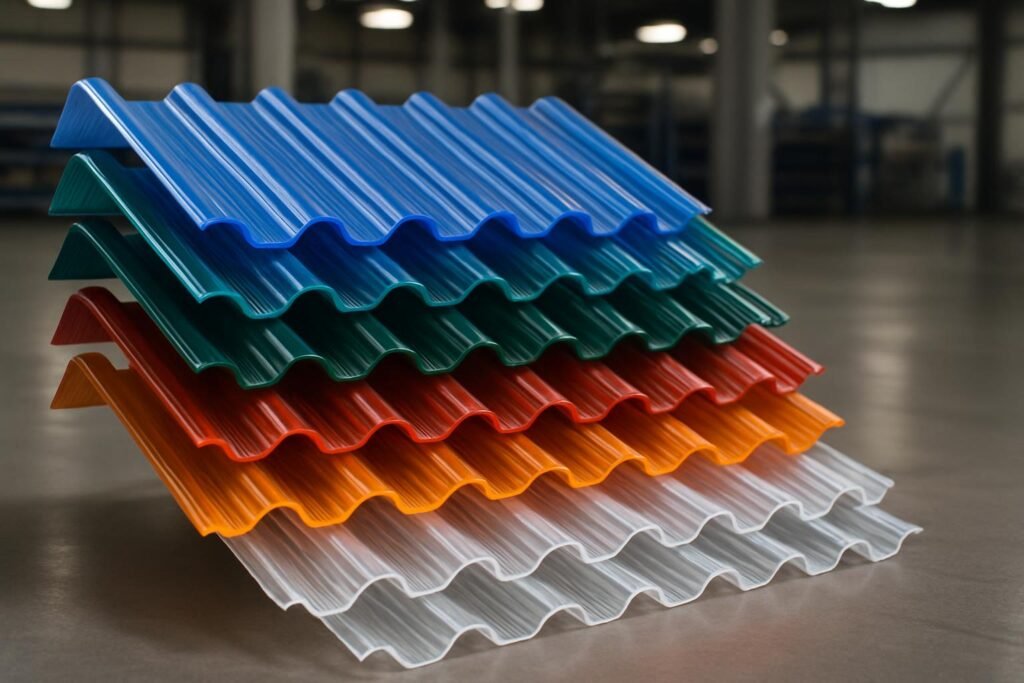
Corrugated Polycarbonate Sheet
Wave and profiled sheets for roofing, daylight strips, canopies, patios, greenhouses and profile matching.
- Profile drawing and effective width required
- Clear, colored and translucent options
- Side overlap and fastening review
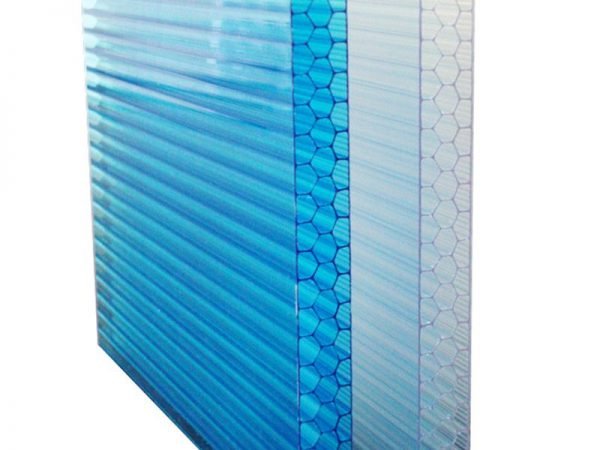
Honeycomb Polycarbonate Sheet
A cellular multiwall structure for selected skylights, roofs and projects requiring greater internal panel structure.
- Honeycomb or reinforced cell geometry
- Grade-specific transmission and insulation
- Edge sealing and connector selection
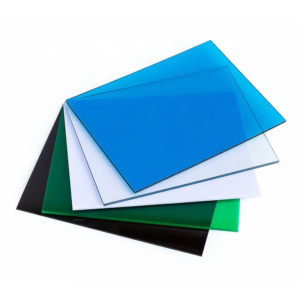
Textured Polycarbonate Sheet
Embossed or patterned sheet for privacy glazing, light diffusion, decorative panels and selected interior applications.
- Texture code and pattern direction
- Light diffusion and privacy level
- One-side texture or approved surface
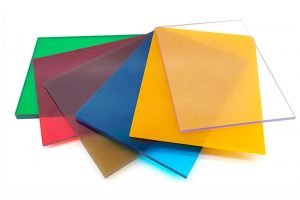
Flame-Retardant Polycarbonate
Specialty sheet grades for projects requiring defined flammability or surface-burning documentation.
- Exact standard and rating required
- Thickness and mounting must match report
- Do not describe untested sheets as fireproof

Polycarbonate Roofing Panels
Panel-and-connector roofing systems for commercial skylights, walkways, transport buildings and large roof zones.
- Panel width and connection profile
- Wind, snow, support and drainage review
- Ridge, edge and penetration details
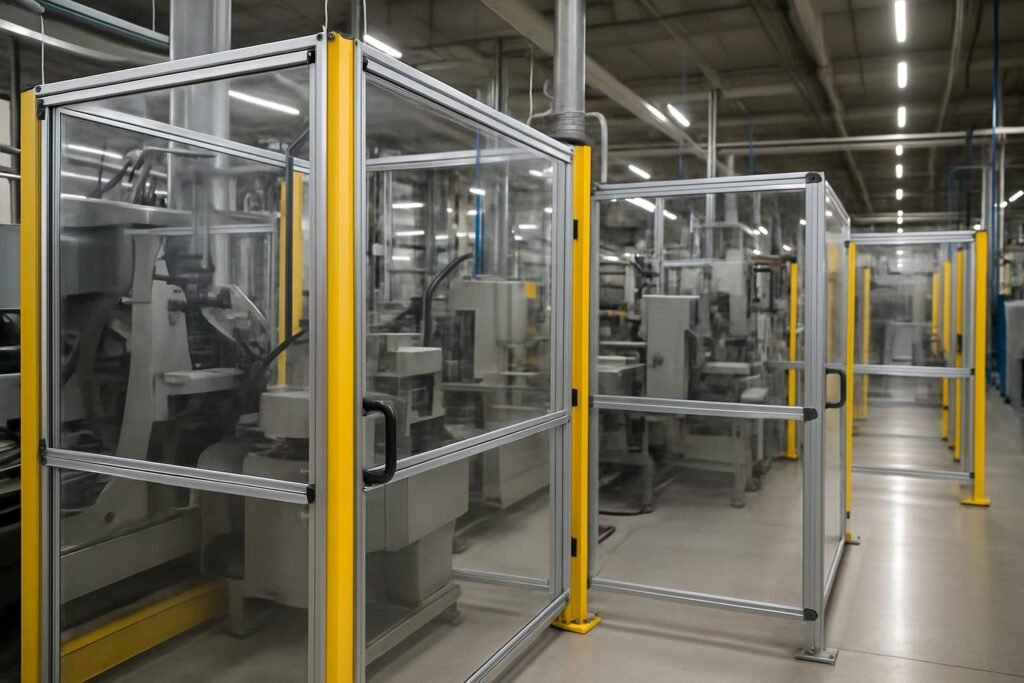
Fabricated Polycarbonate Panels
Cut, drilled, formed or machined components for guards, covers, windows and project-specific assemblies.
- CAD drawing and tolerances required
- Edge, hole and bend details
- Protective film and finished-part packing
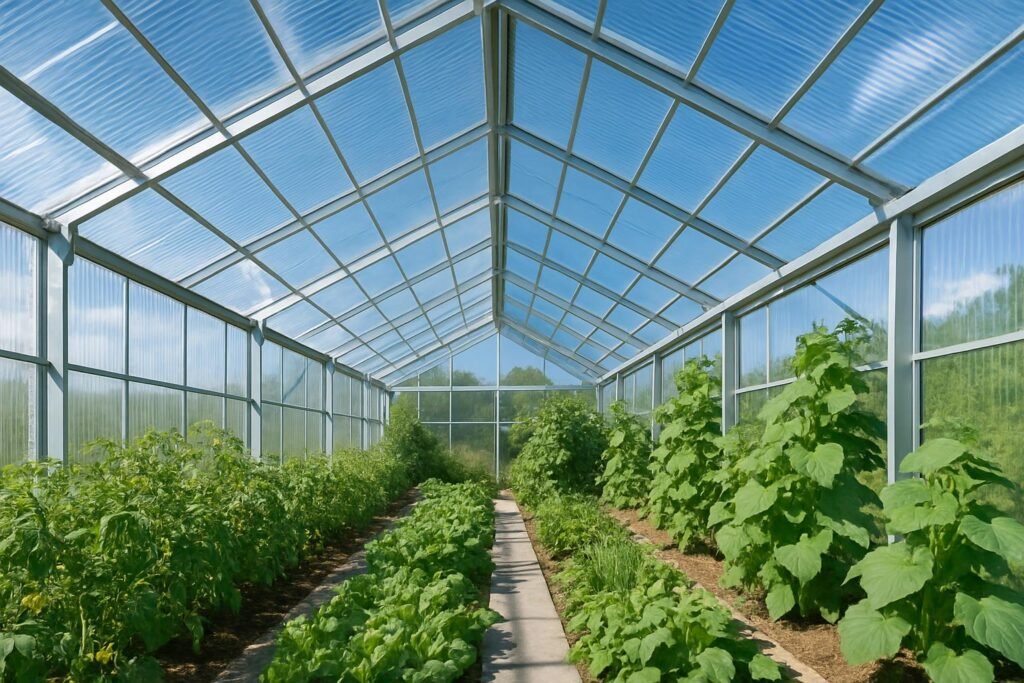
Greenhouse & Skylight Panels
Application-specific sheet selection for crop light, insulation, condensation, ventilation and structural requirements.
- Transmission and diffusion target
- Anti-condensation option by grade
- Frame spacing and edge sealing
Product selection
Which polycarbonate sheet should you choose?
| Requirement | Recommended starting point | Important confirmation |
|---|---|---|
| Clear safety glazing | Solid polycarbonate | Thickness, impact requirement, UV side and fixing |
| Greenhouse covering | Multiwall or corrugated sheet | Crop light, insulation, condensation and frame spacing |
| Roof insulation | Multiwall or honeycomb structure | Wall geometry, U-value data, supports and connectors |
| Canopy or patio | Solid, corrugated or roofing system | Roof slope, wind, support, drainage and thermal movement |
| Machine guard | Solid polycarbonate | Impact risk, thickness, frame, holes and cleaning agents |
| Privacy or glare control | Textured or opal sheet | Texture, transmission, diffusion and appearance sample |
| Defined fire requirement | Flame-retardant grade | Standard, rating, thickness, color and mounting |
| Large architectural roof | Integrated roofing panel system | System width, connectors, loads, supports and details |
Applications
Polycarbonate sheet applications by project type
Greenhouses
Coordinate crop light, diffusion, insulation, condensation, ventilation and sheet orientation.
Machine Guards
Review impact hazard, thickness, visibility, frame openings, fasteners and cleaning chemicals.
Skylights & Daylighting
Select panel structure, light transmission, heat gain, supports and water-management details.
Domes & Architectural Glazing
Confirm cold or hot forming radius, sheet orientation, support, UV side and fabrication quality.
Commercial Roofing
Use system-specific panels, connectors, wind/snow data, slope, drainage and thermal movement.
Transport & Public Buildings
Coordinate impact, fire, smoke, optical, structural and regulatory requirements.
Published product data
Dimensions and technical values published on the live product pages
| Product family | Current published reference | Typical use | Required confirmation |
|---|---|---|---|
| Solid polycarbonate sheet |
Published standard-sheet thickness entries:
0.8, 1, 1.5, 2, 2.5, 3, 4, 5, 6, 8, 10, 12, 15, 16, 18, 20,
25, 30, 35 and 40 mm. Published widths by thickness group: 610, 1000, 1050, 1220, 2100 and 2650 mm. Published flat lengths: 1220, 2440, 5800 and 11800 mm. Published roll lengths for selected 0.8–1.5 mm sheets: 30, 40 and 50 m. |
Safety glazing, machine guards, canopies, fabrication and transparent barriers | Use the exact thickness/width/length combination shown on the approved quotation; not every width is available at every thickness. |
| Corrugated polycarbonate sheet |
Published thickness columns: 0.8, 1.0, 1.5 and 2.0 mm. Published profile-width entries: 600, 750, 756, 840, 850, 910, 935, 939.2, 1000, 1032, 1050, 1069, 1075, 1078 and 1090 mm. Published clear-sheet light transmission: >88% by ASTM D1003. |
Canopies, patios, greenhouses, skylights, storage sheds and profiled roof daylighting | Confirm profile drawing, total width, effective width, wave pitch, wave height, side overlap and fastening position. |
| Honeycomb polycarbonate sheet |
Density: 1.2 g/cm³. Light transmittance: >76% by ASTM D1003. Short-term service temperature: −50 to +120°C. Long-term service temperature: −40 to +100°C. Linear thermal expansion: 0.065 mm/m·°C. Thermal conductivity: 0.21 W/m·K. |
Skylights, stadium roofs, insulated daylight panels and selected greenhouse projects | Confirm exact honeycomb cell structure, thickness, panel width, U-value/load table and anti-condensation coating. |
| Textured polycarbonate sheet |
Published structure: textured on one side and smooth on the other. Density: 1.2 g/cm³. Tensile strength at yield: >60 MPa. Tensile strength at break: >65 MPa. Linear thermal expansion: 0.065 mm/m·°C. Thermal conductivity: 0.21 W/m·K. Flexural strength: 100 MPa. UL 94: V-2. |
Privacy screens, conference-room glazing, light diffusers and decorative glazing | Confirm texture code, sheet thickness, dimensions, color, light transmission and UV-protected side. |
| Flame-retardant polycarbonate |
Published thickness entries:
0.125, 0.175, 0.25, 0.375, 0.5, 0.75, 1, 1.5, 2, 2.5, 3,
4, 5, 6, 8, 10, 12, 15, 16, 18 and 20 mm. Published widths: 1000, 1220, 2100 and 2650 mm, depending on thickness. Published ratings: UL 94 V-2/V-0 and ASTM E84 Class B/Class A by grade. Light transmittance: 80–91% by ASTM D1003. |
Electrical, transport, industrial and construction projects with a defined fire-test requirement | The supplied grade, thickness, color, mounting and report number must match the required fire classification. |
| Polycarbonate roofing panel system |
Normal colors: clear, bronze, opal white, green and blue. Dual-surface colors: bronze/opal white and solar-control/opal white. Solar-control colors: reflective grey, reflective blue, Solar Ice, Pearl, Absorbed Green and Absorbed Blue. |
Commercial skylights, stations, stadiums, airports, walkways, carports and large roof zones | Confirm panel width, lock/connector profile, support spacing, wind/snow data, slope, drainage and warranty for the quoted system. |
The data above is taken from the current individual product pages. The final quotation must identify the exact product, grade, size and report supplied.
| Property | Published value | Published test method | Product-page source within the website |
|---|---|---|---|
| Density | 1.2 g/cm³ | ASTM D792 / D-792 | Solid, corrugated, honeycomb, textured, flame-retardant and roofing-panel pages |
| Linear thermal expansion | 0.065 mm/m·°C | ASTM D696 / D-696 | Solid, corrugated, honeycomb, textured, flame-retardant and roofing-panel pages |
| Thermal conductivity | 0.21 W/m·K | ASTM C177 / C-177 | Solid, corrugated, honeycomb, textured, flame-retardant and roofing-panel pages |
| Short-term service temperature | −50 to +120°C or −50 to +130°C, depending on product page | Published product value | −50 to +120°C on corrugated/honeycomb pages; −50 to +130°C on solid/roofing-panel pages |
| Long-term service temperature | −40 to +100°C | Published product value | Solid, corrugated, honeycomb and roofing-panel pages |
| Tensile modulus | 2350–2400 MPa | ASTM D638 / D-638 | 2350 MPa on solid/roofing-panel pages; 2400 MPa on corrugated/honeycomb/textured/flame-retardant pages |
| Flexural strength | 100 MPa | ASTM D790 / D-790 | Published on the individual product pages |
| Clear solid-sheet light transmission | 82–92% | ASTM D1003 / D-1003 | Solid polycarbonate sheet page |
| Corrugated clear-sheet light transmission | >88% | ASTM D1003 | Corrugated polycarbonate page |
| Honeycomb light transmittance | >76% | ASTM D1003 | Honeycomb polycarbonate sheet page |
| Flame-retardant-sheet light transmittance | 80–91% | ASTM D1003 | Flame-retardant polycarbonate page |
These are published typical values. The current grade-specific datasheet, batch documentation and project load table remain the controlling documents.
Optical selection
Light transmission is only one part of optical performance
Select clear, tinted, opal or textured sheets according to the desired visibility, daylight distribution, glare and solar heat.
Performance factors
How to evaluate polycarbonate sheet performance
Impact performance
Define the hazard, impact method, temperature, support condition and pass/fail requirement.
Panel stiffness
Thickness, wall structure, profile depth, width, support spacing and load act together.
Thermal insulation
Multiwall air spaces may improve insulation; confirm the current U-value or thermal data.
Thermal expansion
Allow movement in holes, connectors, edge engagement, sheet length and framing details.
Weathering
Outdoor performance depends on UV layer, exposure side, color, thickness and maintenance.
Chemical compatibility
Confirm sealants, cleaners, lubricants, coatings and process chemicals before contact.
UV protection
Install the protected surface in the correct direction
Some outdoor sheets use a co-extruded UV-protective layer on one side, while other products may use two-sided protection. Confirm the marked exposure side and do not remove protective film until the correct installation stage.
- One-side or two-side UV layer
- Printed protective-film marking
- Outdoor-facing surface
- Weathering test method
- Yellowing or transmission retention
- Cut-edge exposure
- Storage before installation
- Cleaning compatibility
Fire documentation
Flame-retardant is not the same as fireproof
Fire behavior depends on the formulation, sheet structure, thickness, color, mounting, joints, air cavity and test standard. The report must match the exact product being supplied.
- Required test standard
- Exact grade and product code
- Tested thickness
- Color and surface
- Mounting orientation
- Complete assembly
- Report date and laboratory
- Local project approval
Color options
Choose color by light, heat and architectural appearance
Connection system
Plan sheets, profiles, fasteners and seals together
H connection profiles
Join adjacent panels while maintaining edge engagement and movement allowance.
U edge profiles
Close or protect panel ends according to the multiwall ventilation and sealing detail.
Aluminum glazing bars
Clamp panels to the supporting frame with gaskets and system-specific caps.
Fasteners and washers
Use compatible materials, hole allowance, spacing and tightening pressure.
Breather and sealing tape
Control dust, insects and condensation at open multiwall sheet channels.
Compatible sealant
Confirm chemical compatibility; unsuitable sealants can damage or stress the sheet.
Ridge and wall flashing
Coordinate water management at ridges, walls, edges and roof penetrations.
Support frame
Review support material, spacing, surface width, drainage and corrosion protection.
Installation workflow
Four steps before installing polycarbonate sheets
Confirm sheet orientation
Identify UV side, channel direction, roof slope, lap direction and protective film.
Prepare supports
Check frame spacing, support width, alignment, drainage and contact materials.
Cut, drill and connect
Use suitable tools, clean channels and provide expansion allowance in holes and profiles.
Seal and inspect
Complete edges, joints, flashing and drainage; then remove film and inspect the surface.
Material comparison
Solid vs multiwall vs corrugated vs FRP glazing
| Selection factor | Solid polycarbonate | Multiwall polycarbonate | Corrugated polycarbonate | FRP translucent sheet |
|---|---|---|---|---|
| Structure | Solid flat sheet | Hollow twin-wall or multiwall | Single profiled sheet | Resin with fiberglass reinforcement |
| Primary strength | Clear glazing, impact and fabrication | Lightweight glazing with insulating air spaces | Simple profiled roofing and daylight strips | Industrial daylighting and resin-selected exposure |
| Optical appearance | Clear, tinted, textured or opaque grades | Visible internal walls; clear, opal or colors | Profiled transparent or translucent appearance | Diffused appearance influenced by glass pattern and resin |
| Connection priority | Frame, holes, gasket and edge support | Profiles, channel sealing and expansion | Profile overlap, effective width and fasteners | Profile matching, side laps and fasteners |
| Thermal insulation | Confirm by thickness and assembly | Air spaces can provide greater insulation | Generally a single profiled layer | Confirm by selected product construction |
| Best next page | Solid sheet | Honeycomb multiwall | Corrugated sheet | FRP sheet |
Quality control
Inspection points for polycarbonate sheet orders
Raw-material and grade record
Identify the approved product code, resin grade, additives, color and production batch.
Thickness and dimensions
Measure length, width, thickness and wall/profile geometry using the agreed method.
Sheet weight
Check sheet or area weight when the product specification includes a defined value.
Optical inspection
Inspect transmission, haze, color, inclusions, black spots, bubbles and visible distortion.
UV-layer identification
Confirm the protected side, film marking and current weathering evidence.
Impact or mechanical testing
Use the project’s required method, thickness, support and temperature conditions.
Profile or connector fit
Trial-fit corrugated sheets, multiwall profiles, gaskets and connection components.
Fire documentation
Check exact product, color, thickness, standard, mounting and report validity.
Protective film and packing
Inspect film adhesion, surface protection, edge condition, labels and pallet stability.
OEM & fabrication
Polycarbonate customization capabilities to discuss
Thickness and sheet size
Confirm current extrusion range, standard widths, cut lengths and dimensional tolerance.
Wall or profile structure
Review twin-wall, multiwall, honeycomb, corrugated or system-panel geometry.
Color and optical grade
Discuss clear, bronze, opal, blue, green, grey, diffusion or solar-control requirements.
UV and specialty layers
Confirm one-side/two-side UV, anti-condensation or specialty surface options by product.
Cutting and machining
Provide CAD drawings for cut size, holes, slots, routing, forming or finished components.
Private-label packaging
Coordinate film printing, labels, barcodes, cartons, pallets and distributor information.
Packing & logistics
Protect optical surfaces and hollow channels during shipment
Published data summary
Confirmed values used on this collection page
RFQ checklist
Send the product structure and project requirement together
A complete inquiry allows the factory to review the correct sheet, accessories, fabrication, technical documents, packing and quotation.
- Project country and application
- Buyer type or company
- Solid, multiwall or corrugated type
- Required wall/profile structure
- Thickness
- Width and length
- Color and transparency
- Light-transmission target
- UV protection requirement
- Fire standard or rating
- Impact requirement
- Wind, snow or support spacing
- Connection profiles
- Fasteners, gaskets and sealant
- Cutting or fabrication drawing
- Order quantity
- Private-label packaging
- Destination port
Related pages
Continue through the polycarbonate content cluster
Frequently asked questions
Polycarbonate sheet purchasing questions
Solid polycarbonate is a flat solid panel used for clear glazing, protection and fabrication. Multiwall polycarbonate contains internal walls and air spaces that reduce weight and can improve thermal insulation.
Published solid-sheet entries include 0.8–40 mm standard-sheet sizes; corrugated pages list 0.8, 1.0, 1.5 and 2.0 mm; flame-retardant pages list 0.125–20 mm. Selection still depends on structure, panel size, support spacing and loads.
Multiwall or corrugated sheets are common starting points. Final selection should consider crop light, diffusion, insulation, condensation, UV layer, ventilation, frame spacing and climate.
Yes, when the exact grade is intended for outdoor use and the UV-protected surface is installed in the correct direction. Confirm weathering data and warranty conditions.
Published options include clear, bronze, opal white, green and blue, plus grade-specific grey, red, yellow, brown, dual-surface and solar-control colors. The quotation must state the exact product, color and light-transmission value.
Do not use “unbreakable” as an absolute engineering claim. Polycarbonate has high impact performance, but the result depends on grade, thickness, support, temperature, impact method and installation.
No. Flame-retardant grades may meet defined test classifications. The standard, rating, thickness, color, mounting and report must match the supplied product.
Use the coefficient and installation guidance for the exact product together with sheet length and temperature range. Provide movement allowance in holes, profiles and edge engagement.
Do not assume every sealant is compatible. Use a sealant approved for polycarbonate and confirm compatibility with the sheet, coating, gasket and environment.
Yes, depending on type and thickness. Use suitable tools, support the sheet, protect the surface, clean multiwall channels and follow the fabrication guide.
Use the approved combination of sealing or breather tape and edge profiles according to panel orientation, condensation and drainage requirements.
Provide the application, sheet type, structure, thickness, width, length, color, optical target, UV side, fire or impact requirements, accessories, quantity and destination.
Request polycarbonate sheet samples and a quotation
Send the application, sheet structure, thickness, dimensions, color, UV requirement, technical documents, quantity and destination port.