
Corrugated Plastic Sheet Solutions
Professional Polypropylene (PP) Hollow Board
Lightweight fluted polypropylene boards for reusable packaging, layer pads, floor and surface protection, temporary partitions, signs, displays and industrial conversion projects.
- Hollow twin-wall / fluted construction
- Moisture-resistant PP material
- Custom size, color and surface review
- Cutting, creasing, printing and fabrication review
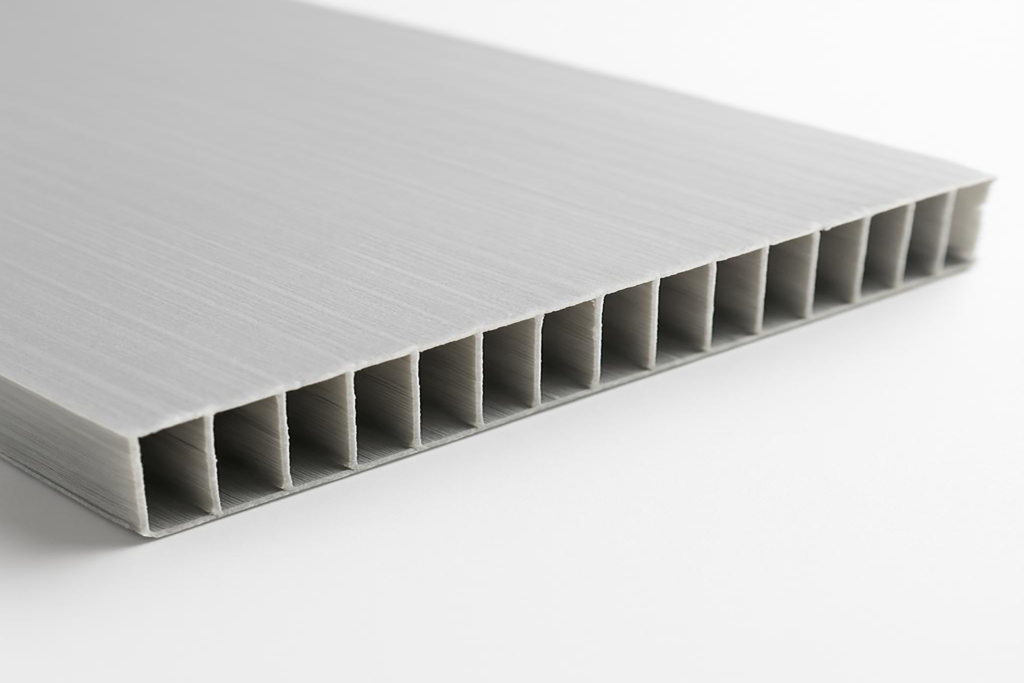
PP hollow board is an extruded polypropylene sheet with two outer skins connected by internal ribs or flutes. The hollow structure reduces material usage and weight compared with a solid sheet while retaining a flat, cuttable panel format.
It is also called PP corrugated sheet, corrugated plastic board, fluted plastic sheet or twin-wall polypropylene board. Finished performance depends on thickness, flute geometry, areal weight, resin grade, additives, temperature, load direction, converted design and support.
Supply formats
PP sheet formats and conversion options
PP Hollow / Fluted Board
Extruded twin-wall sheet for packaging, pads, protection, partitions, signs and fabricated returnable products.
- Thickness and areal weight confirmed on quotation
- Flute direction marked for cutting and folding
- Color and surface treatment confirmed by sample
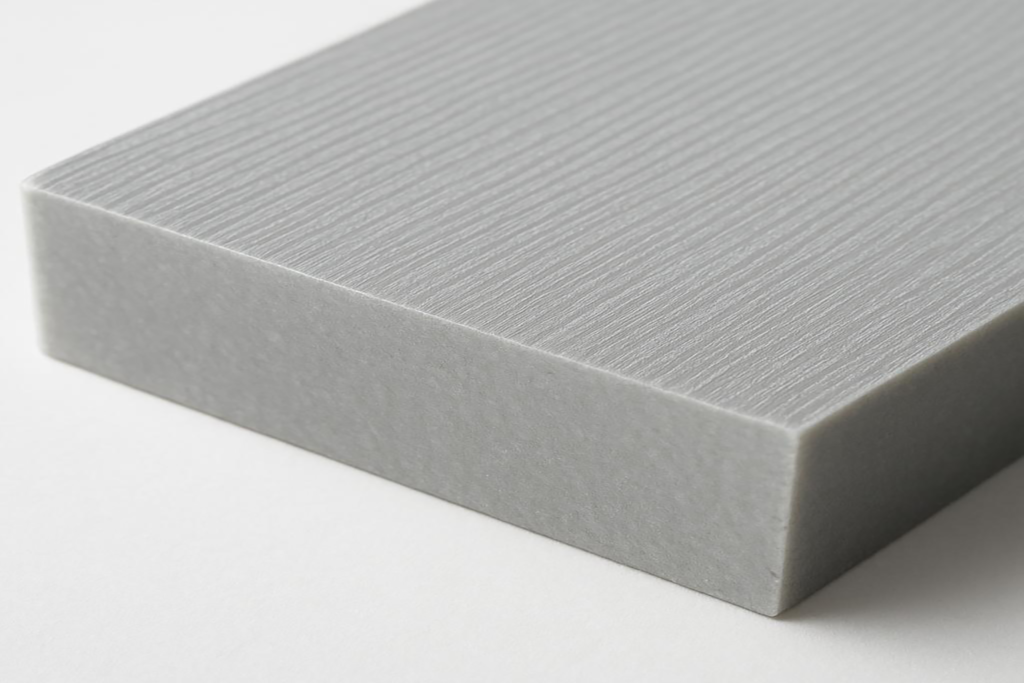
PP Solid Board
Solid polypropylene sheet is a different structure used when the project requires a continuous cross-section rather than hollow flutes.
- Higher material content than hollow board
- Machining, lining and fabrication reviewed separately
- Do not transfer hollow-board weight or stiffness data

Converted PP Board Parts
Cut blanks, scored parts, dividers, layer pads, boxes, trays, signs or printed panels can be reviewed against drawings and quantity.
- CAD drawing or finished-part sample required
- Cut, crease, print, weld and assembly specified
- Tooling and tolerance approved before mass production
Board anatomy
The flute structure controls direction and conversion
Sheet orientation must be defined before cutting, folding, printing or loading because the ribs create directional behavior.
Verified data disclosure
What is confirmed and what must be confirmed by quotation
| Specification item | Current verified status | Required order information |
|---|---|---|
| Base material | Polypropylene (PP) | Resin grade, virgin/recycled-content requirement and additive package |
| Board construction | Hollow / fluted twin-wall board | Flute geometry, flute direction and edge requirement |
| Finished thickness | No reliable public factory range is currently published | Required nominal thickness and tolerance |
| Width and length | No reliable public factory size table is currently published | Finished sheet or blank dimensions and cutting tolerance |
| Areal weight / grammage | No reliable public value is currently published | Required g/m² or approved physical sample |
| Color | Custom color review is stated on the current website | Color reference, sample, tolerance and minimum order |
| Surface treatment | Custom surface-treatment review is stated on the current website | Printing treatment, corona level, texture, matte/gloss or other requirement |
| Outdoor use | No verified universal outdoor-life statement is published | UV-stabilized grade, climate, exposure side and warranty requirement |
| Static control | No anti-static or conductive value is currently published | Required surface resistance range and test method |
| Fire performance | No verified universal rating is currently published | Exact standard, classification, thickness, color and report |
| Finished-part conversion | Must be reviewed by project | Drawing, folds, slots, holes, print, weld, assembly and tolerance |
Typical PP resin density is approximately 0.90–0.905 g/cm³ in major resin-supplier literature. This is a base-resin reference and must not be used as the finished board’s bulk density, grammage or shipping weight.
Main applications
Where PP hollow boards are commonly specified
Reusable Packaging
Returnable boxes, totes, dividers and handling containers for controlled logistics cycles.
Layer Pads & Separators
Flat pads between bottles, cans, parts, cartons or pallet layers.
Floor & Surface Protection
Temporary protection during construction, decoration, transport and installation work.
Partitions & Dividers
Temporary internal partitions, bin dividers, product separators and storage organization.
Signs & Displays
Printed signs, campaign boards, display panels and short-term promotional structures.
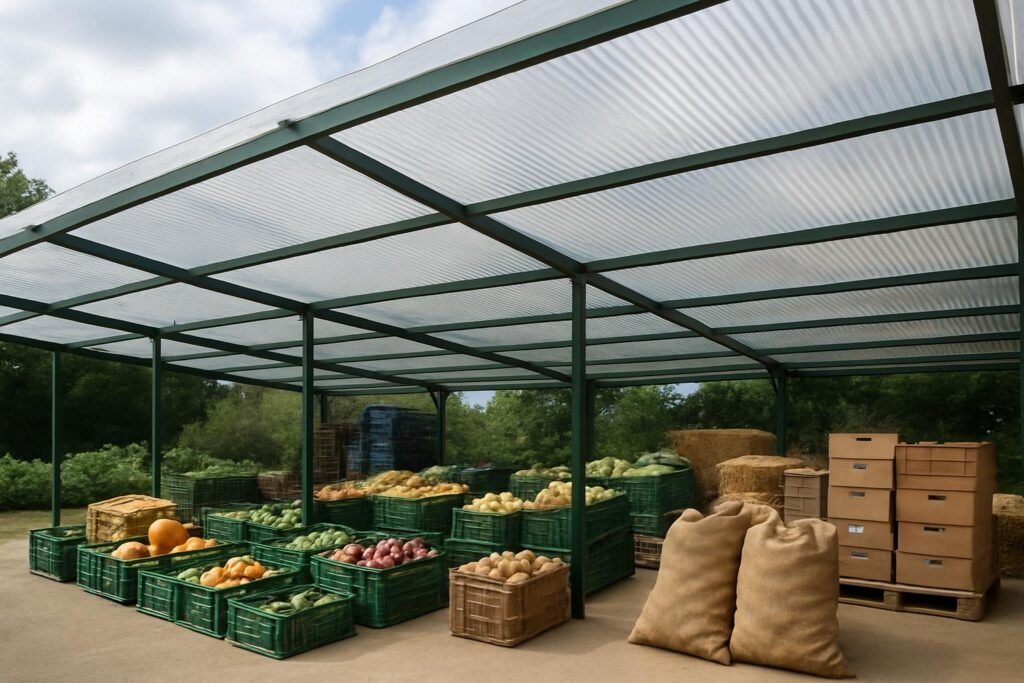
Agricultural Protection
Produce separators, plant guards, tray liners and washable agricultural handling panels.
Automotive & Industrial Pads
Parts separators, work-in-process trays and surface-protection layers.
Appliance & Furniture Protection
Corner, face and interlayer protection during assembly, storage and delivery.
Custom Converted Components
Die-cut, folded, welded or printed pieces produced from approved drawings.
Application review
Three environments with different board requirements
Agricultural & Produce Handling
Review wash-down, food-area rules, temperature, box design, drainage and repeated handling.
Factory Packaging & Part Separation
Define load, stacking, part shape, abrasion, oils, cleaners and return cycles.
Industrial Protection & Barriers
Use project-specific framing, fixing, visibility, impact and fire requirements.
Board selection
Select thickness and grammage from the converted design
| Use case | Primary selection factors | Recommended verification |
|---|---|---|
| Single-use separator | Flatness, cleanliness, part size, cost and recycling route | Physical sample and packing trial |
| Reusable box or tote | Panel load, fold design, joints, handles, stacking and wash cycles | Prototype box and loaded stacking test |
| Pallet layer pad | Layer load, moisture, slip, flute direction and pallet dimensions | Compression and real pallet trial |
| Floor protection | Foot traffic, rolling loads, surface friction, joints and duration | Site-area trial on actual floor finish |
| Printed sign | Surface treatment, ink system, flatness, weather exposure and display frame | Printed color and adhesion sample |
| Industrial divider | Part geometry, abrasion, oils, static sensitivity and return cycle | Converted prototype and process test |
Performance factors
How to evaluate a PP hollow board
Compression
Test in the actual load direction with the finished board and converted design.
Bending and stiffness
Flute direction, span, temperature, thickness and grammage change deflection.
Impact and puncture
Define the object, shape, speed, support and acceptable damage before testing.
Moisture exposure
PP does not behave like paperboard, but joints, labels, printing and trapped water still require review.
Chemical contact
Confirm oils, detergents, disinfectants, solvents and process chemicals with the exact grade.
Temperature and UV
Outdoor and elevated-temperature use requires a grade and additive package approved for the exposure.
Recycling and reuse
“Recyclable” depends on design and local collection
A single-material polypropylene board can be technically recyclable, but labels, inks, adhesives, mixed inserts, contamination and local collection systems determine whether it is actually recycled.
- Single-material construction
- Label and adhesive choice
- Ink and coating removal
- Metal or textile inserts
- Cleaning and contamination
- Local PP collection route
- Reuse-cycle tracking
- End-of-life separation
Outdoor, fire and static control
Special performance requires a special grade
Standard PP hollow board should not automatically be described as UV-stable, flame-retardant, anti-static, conductive or food-contact compliant.
- Outdoor exposure period
- UV-stabilized formulation
- Fire test standard
- Surface-resistance range
- Anti-static decay requirement
- Food-contact regulation
- Cleanroom requirement
- Current grade-specific report
Conversion workflow
From flat sheet to a finished PP board component
Approve the drawing
Define finished dimensions, flute direction, folds, holes, slots, joints and tolerance.
Approve the board
Confirm thickness, grammage, color, surface, treatment and physical sample.
Trial the conversion
Check cutting, creasing, folding, printing, welding and assembly on a prototype.
Validate the use
Test loading, stacking, transport, cleaning and reuse in the actual process.
Printing and surface treatment
Approve ink adhesion on the exact board surface
Polypropylene has a low-surface-energy character, so printing, gluing and labelling should be tested after the selected surface treatment.
Material comparison
PP hollow board vs solid PP, cardboard and PVC board
| Selection factor | PP hollow board | Solid PP board | Corrugated cardboard | Rigid PVC board |
|---|---|---|---|---|
| Structure | Twin-wall skins with internal PP flutes | Continuous solid polypropylene section | Paper liners and fluted paper medium | Solid, foamed or profile-based PVC construction |
| Typical strength | Lightweight reusable packaging, pads, partitions and signs | Machining, lining and heavier fabrication | Low-cost packaging and shipping cartons | Interior panels, signs and project-specific rigid components |
| Moisture behavior | PP sheet is not paper-based; finished design and print still require review | PP material with continuous section | Performance can fall when paper absorbs moisture | Moisture-resistant plastic board; grade and joints matter |
| Directional behavior | Flute direction strongly affects bending and folding | More uniform through the section | Flute direction affects compression and bending | Depends on board construction |
| Conversion | Cut, crease, fold, print, weld or assemble after trial | Cut, drill, machine, weld or fabricate | Cut, crease, print, glue or staple | Cut, machine, print or thermoform by grade |
| Related page | Current PP hollow board page | Request a solid PP quotation | Not a current website product family | PVC Decorative Board |
Quality control
Inspection points for PP hollow board orders
Material and batch identity
Record the approved resin/additive grade, color and production batch.
Length, width and squareness
Measure finished sheet or blank dimensions and diagonal alignment.
Overall thickness
Measure at agreed positions and report the approved tolerance.
Areal weight
Check g/m² or finished-piece weight using the agreed sample plan.
Flute and skin condition
Inspect rib continuity, crushed channels, thin areas, holes and edge damage.
Flatness and warpage
Define measurement support, temperature and maximum accepted deviation.
Color and surface
Compare against the signed sample under agreed lighting and surface conditions.
Conversion accuracy
Check cuts, creases, folds, holes, slots, welds, print and assembled dimensions.
Packing inspection
Verify quantity, labels, bundles, pallets, edge protection and loading stability.
Packing & logistics
Keep sheets flat, clean and correctly identified
RFQ checklist
Send the board and finished-use requirements together
A complete enquiry allows the factory to review the correct sheet and conversion route.
- Project country and company
- Application
- Flat sheet or converted part
- Required thickness
- Required width and length
- Areal weight / grammage
- Flute direction
- Color and tolerance
- Surface texture
- Corona or printing treatment
- Print artwork and colors
- Cut, crease, hole and slot drawing
- Welding or assembly requirement
- UV, fire or static requirement
- Food-contact or cleanroom requirement
- Order quantity
- Bundle or pallet packaging
- Destination port
Related pages
Continue through the product and company pages
Frequently asked questions
PP hollow board purchasing questions
It is an extruded polypropylene twin-wall sheet with outer skins connected by internal ribs or flutes. It is also called PP corrugated sheet or fluted plastic board.
Common uses include reusable packaging, boxes, dividers, layer pads, floor protection, temporary partitions, signs, displays and converted industrial components.
The current website does not publish a reliable factory size table. Send the required thickness, width, length, grammage and quantity so availability can be confirmed in the quotation.
Boards with the same nominal thickness may use different skin thicknesses, rib spacing and material content. Grammage or areal weight helps define the supplied construction.
Yes. It can affect bending, compression, folding, drainage, printing orientation and the finished-part design. Mark the flute direction on the drawing.
It can be printed after suitable surface preparation and process testing. Confirm corona or other treatment, ink system, artwork, adhesion and rub resistance.
Outdoor use requires a grade approved for UV and weather exposure. The current website does not support one universal outdoor-life claim for all PP hollow boards.
The polypropylene sheet does not behave like water-absorbing paperboard, but cut channels, joints, print, labels and the converted design still require moisture and drainage review.
A clean single-material PP design can be technically recyclable where local systems accept polypropylene. Mixed inserts, labels, inks and contamination can affect recycling.
Special static-control requirements must be confirmed by grade. State the required surface-resistance range, test method and operating environment.
These conversion methods can be reviewed using the exact board and finished-part drawing. A prototype should be approved before mass production.
Provide the application, thickness, dimensions, grammage, flute direction, color, surface, printing, conversion drawing, special performance, quantity, packaging and destination.
Request PP hollow board samples and a quotation
Send the sheet size, thickness, grammage, flute direction, color, printing or conversion drawing, quantity, packing and destination port.