
Pultruded fiberglass structural profiles
FRP Profiles for Corrosion-Resistant Structures
Pultruded fiberglass angles, channels, tubes, rods, flat strips and custom sections for industrial platforms, handrails, frames and non-metallic structures.
- Standard and custom cross-sections
- Resin and colour options
- Cutting and drilling from drawings
Product Overview
What Are Pultruded FRP Profiles?
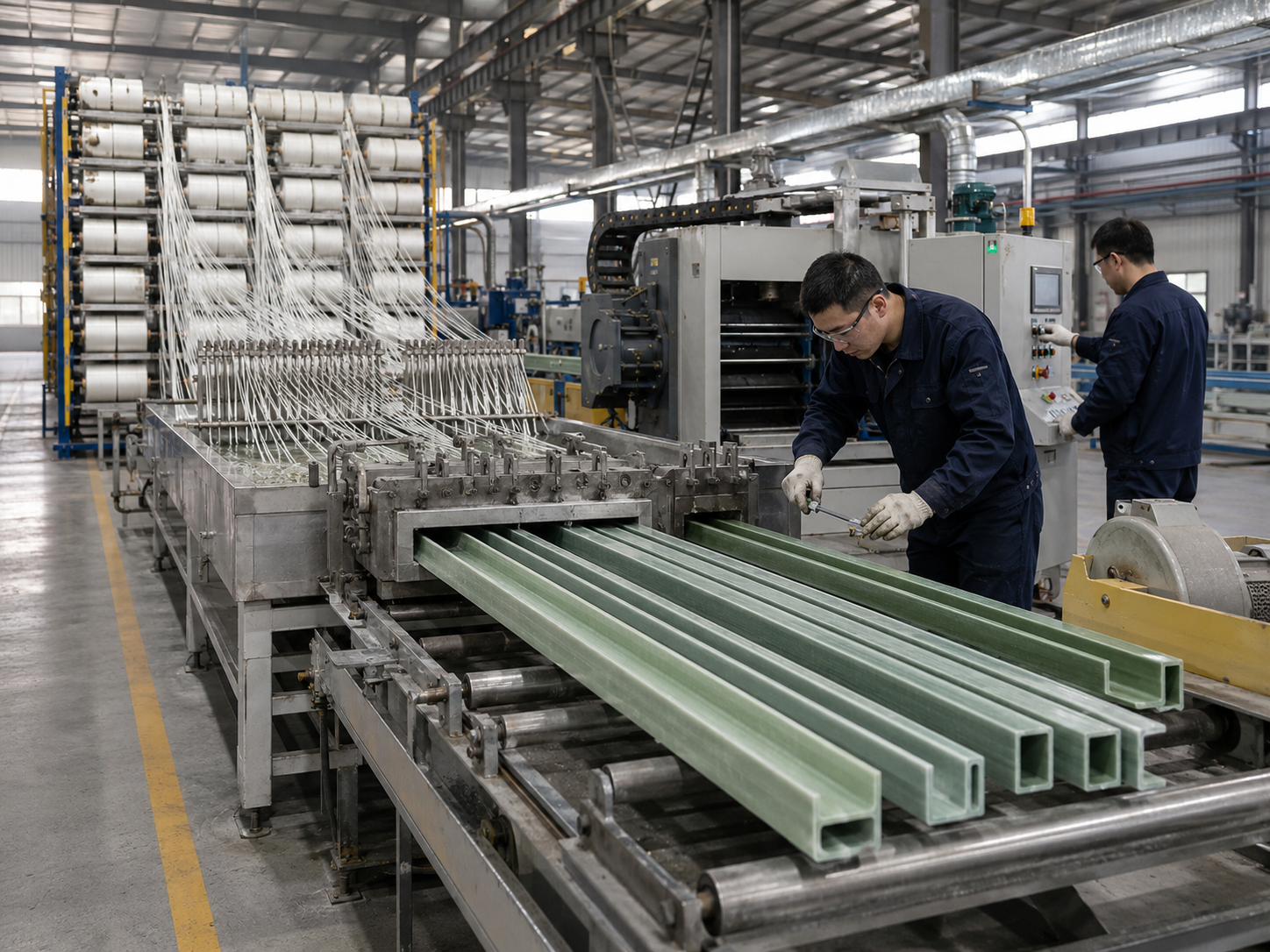
FRP profiles are constant-cross-section components made by pulling continuous fiberglass reinforcement through resin and a forming die. The resulting pultruded shapes are commonly used where corrosion resistance, low maintenance or electrical insulation is more important than using conventional metal sections.
Profile performance depends on cross-section, fibre architecture, resin, surface veil, span, connections and service environment. Final structural use must follow project engineering and grade-specific data.
- Angles and channels
- Square/rectangular tubes
- Round tubes and rods
- Flat strips and bars
- Custom pultruded sections
- Cut-to-length processing
Profile Range
Select the Required Cross-Section
Send section dimensions, wall thickness, cut length, quantity and application for an accurate review.
FRP Angles
Equal or unequal angle profiles for frames, brackets, edging and structural assemblies.
FramesSupportsFRP Channels
U- and C-type channel sections for supports, rails, frames and equipment structures.
ChannelsRailsSquare & Rectangular Tubes
Closed hollow sections for handrails, posts, frames and modular assemblies.
PostsFramesRound Tubes & Rods
Circular hollow or solid profiles for handles, supports, spacers and fabricated parts.
TubesRodsFlat Strips & Bars
Flat pultruded sections for bracing, backing, covers and reinforcement components.
StripsBarsCustom Profiles
Project-specific cross-sections evaluated for tooling, fibre placement, tolerance and order volume.
OEMToolingSpecification Guide
FRP Profile Purchasing Specifications
Use a section drawing and performance requirements instead of relying on a generic profile name.
| Item | Options to discuss | Buyer confirmation |
|---|---|---|
| Profile type | Angle, channel, tube, rod, strip or custom section | Dimensioned cross-section drawing |
| Dimensions | Outside dimensions, legs, wall thickness and radii | Nominal size and tolerance |
| Length | Production lengths or cut-to-length pieces | Finished length, tolerance and quantity |
| Resin system | General-purpose or exposure-specific resin options | Chemicals, concentration, temperature and duration |
| Reinforcement | Continuous rovings, mats and veil by profile design | Mechanical and directional load requirements |
| Colour | Standard or referenced project colours where feasible | Colour sample and quantity |
| Surface | Resin-rich veil, smooth or project-specific finish | UV, wear, handling and appearance needs |
| Fabrication | Cutting, holes, slots, notches and assembly review | Part drawing and tolerances |
| Fire performance | Grade-specific options where available | Exact standard, rating and report |
| Packing | Bundles, racks, crates, labels and container plan | Handling limits and destination |
Engineering note: FRP profiles are anisotropic composite components. Allowable loads, spans, connections and safety factors must be established from the exact profile properties, load direction, support conditions, environment and applicable design standards.
Material Selection
Match the Profile to Its Environment
Chemical Exposure
Identify every chemical, concentration, temperature, splash/immersion condition and cleaning method.
Outdoor Weathering
Confirm UV exposure, climate, colour-retention expectation and surface protection requirements.
Electrical Environment
State insulation, conductivity, tracking or project-specific electrical performance requirements.
Structural Loads
Provide load direction, span, support, connection detail, deflection limit and safety requirements.
Temperature Range
Define continuous and short-term operating temperatures plus thermal-cycling conditions.
Fire Requirement
Specify the exact test standard and rating; do not use broad terms such as “fireproof.”
Applications
Where Pultruded FRP Profiles Are Used
Platforms & Walkways
Structural framing and support members for selected industrial access systems.
Handrails & Ladders
Tubes, channels and angles used in non-metallic safety-access assemblies.
Wastewater Facilities
Frames, supports and rails exposed to humidity, gases and treatment chemicals.
Chemical Plants
Profiles selected around defined fumes, splash, temperature and maintenance conditions.
Electrical Infrastructure
Non-metallic supports, cable-management components and equipment framing by grade.
Cooling Towers & Marine
Structural and support profiles reviewed for wet, salt-laden and outdoor environments.
Material Comparison
FRP Profiles vs Steel and Aluminium
| Selection factor | FRP profile | Steel profile | Aluminium profile |
|---|---|---|---|
| Corrosion | Resin-dependent resistance; verify environment | Usually needs suitable coating/protection | Good in many environments; verify specific chemicals |
| Weight | Lower density than common metals | Higher density | Lower density than steel |
| Electrical behaviour | Non-metallic; grade-specific properties | Conductive | Conductive |
| Directional properties | Anisotropic composite; fibre direction matters | Generally isotropic for design purposes | Generally isotropic for design purposes |
| Fabrication | Cut/drill with composite controls and dust management | Weld, cut and drill | Machine, cut and join |
| Key design check | Profile data, deflection, connections and environment | Corrosion, weight and coating maintenance | Alloy, galvanic contact, loads and temperature |
Custom Processing
Profiles Supplied Ready for Assembly
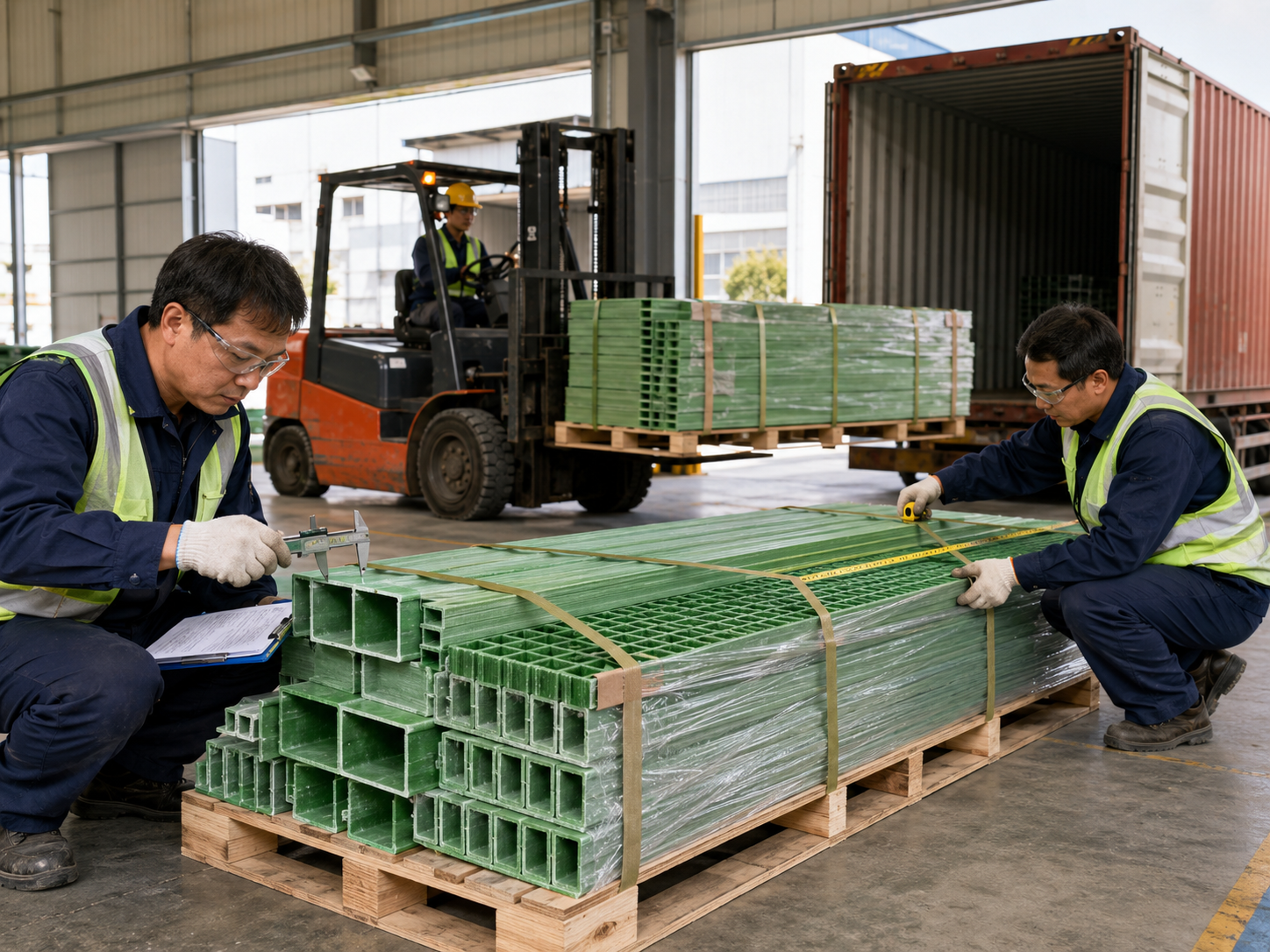
Profiles can be quoted as production lengths or as processed components. Provide a part drawing and assembly context so holes, notches and tolerances can be reviewed.
- Cut-to-length pieces
- Mitre and angle cuts
- Drilled holes
- Slots and notches
- Part marking
- Kit-based packing
- Simple assembly review
- Export bundling
Custom Tooling
Information Required for a New Profile
Section Drawing
Provide complete geometry, wall thicknesses, radii, tolerances and critical surfaces.
Performance
State loads, spans, environment, fire, electrical and dimensional requirements.
Volume
Provide annual demand, first-order quantity, cut lengths and delivery schedule.
Approval
Agree tooling, sample inspection, tests, change control and production acceptance.
RFQ Checklist
Request an FRP profile quotation
Send the cross-section and service conditions so the factory can review the shape, resin, processing and packing.
Please include
- Profile type
- Section drawing
- Dimensions/tolerances
- Cut length
- Resin requirement
- Colour/surface
- Application
- Loads and supports
- Exposure conditions
- Quantity
- Required documents
- Destination port
Related Products
Explore More FRP Products
FRP Flat Sheets
Flat fiberglass panels for linings, cladding and fabricated components.
View FRP flat sheets →FRP Corrugated Sheets
Profiled sheets for industrial roofing, cladding and daylighting.
View FRP corrugated sheets →FRP Sheets
Review the broader FRP product range and material-selection guidance.
Explore FRP sheets →Frequently Asked Questions